
A Multifactor Model of Anger and Irritability: From "Losing It" to Gaining a Sense of Self.

Updated: Apr 7

In popular culture, anger it is often portrayed as a hydraulic force that must be "vented" or a moral failing that must be suppressed. Neither view is accurate, and neither leads to long-term change. If you have ever felt the sudden, hot hijack of a rage episode, you know that "calming down" is often impossible in the moment. If you have ever spent days stewing over a rude comment, replaying the scene in your head until you are exhausted, you know that "letting it go" is easier said than done.
An angry explosion can feel like an uncontrollable force, but that moment of "seeing red" rarely appears in a vacuum. Beneath the surface lies a complex system of contributing factors, and learning to manage these before the pressure builds can save us far more grief than simply trying to contain the blast. The real alternative to an angry outburst isn't quiet submission; it's a calm, goal-oriented response that empowers us to act with clarity.
This article introduces a comprehensive Cognitive Behavioural (CBT) multifactor model of anger. Its focus extends beyond the emotion itself to confront its core problem: the Disorganized Angry Reaction—a critical breakdown in your ability to think clearly and act effectively, precisely when clarity and effectiveness are needed most.
Part 1: Deconstructing the Experience
Before we can treat anger, we must understand its components. Anger is not a monolith; it is a composite of physiology, mood, and habit.
1. Irritability vs. Anger
While closely related, these are distinct experiences.
Irritability is a mood state. It is a "lowered threshold" for reaction. Think of it as the background radiation of your day. When you experience irritability, your system is "on edge," meaning minor stressors (a dropped pen, a slow driver) can feel like major provocations.
Anger is a specific emotion. It is an intense, acute response to a specific trigger—usually a perceived injustice, a blocked goal, or a "trespass" against your values.
2. The Components of the Cycle
Here are four key drivers of anger:
Irritability: The biological "hum" of tension and reactivity.
Behavioral Schemas: Deep-seated beliefs rooted in life experience (e.g., "If I don't fight back, I am a doormat").
Rumination and Fantasy: The mental engine that keeps the fire burning long after the event and primes us for increased reactivity.
The Dysregulated Outburst: The behavioral explosion that causes social and relational damage.
Case Vignette 1: Mei Lin is a quiet, diligent professional from Singapore who avoids confrontation at all costs, terrified that if she speaks up, she will be overwhelmed by the conflict. However, her internal world is a theater of corrective fantasies. When a colleague interrupts her in a meeting, Mei Lin says nothing. But for the next three days, she constructs elaborate fantasies where she delivers a withering, perfect monologue that puts the colleague in their place, leaving the room stunned by her brilliance. Mei Lin believes these fantasies are "processing," but in reality, they are keeping her baseline irritability high. When a real confrontation finally becomes unavoidable, she doesn't deliver the perfect monologue. Her heart races, her mind goes blank, and she becomes anxious and disorganized, stammering through a defense that makes her feel weak. Her reliance on fantasy has left her unprepared for reality.
Part 2: The "Disorganized Reaction" Model
Traditional models often focus too much on anger management. In this model, I argue that managing anger is not possible without accounting for its context. The core failure is not that you experience anger; it is that your reaction becomes disorganized. Much like acute self-consciousness in social anxiety, a disorganized angry reaction occurs when focus narrows so intensely on the perceived threat that executive functioning (your "working cortex") goes offline.
The diagram below shows the interactions between the different elements that play behind the scenes of angry outbursts.
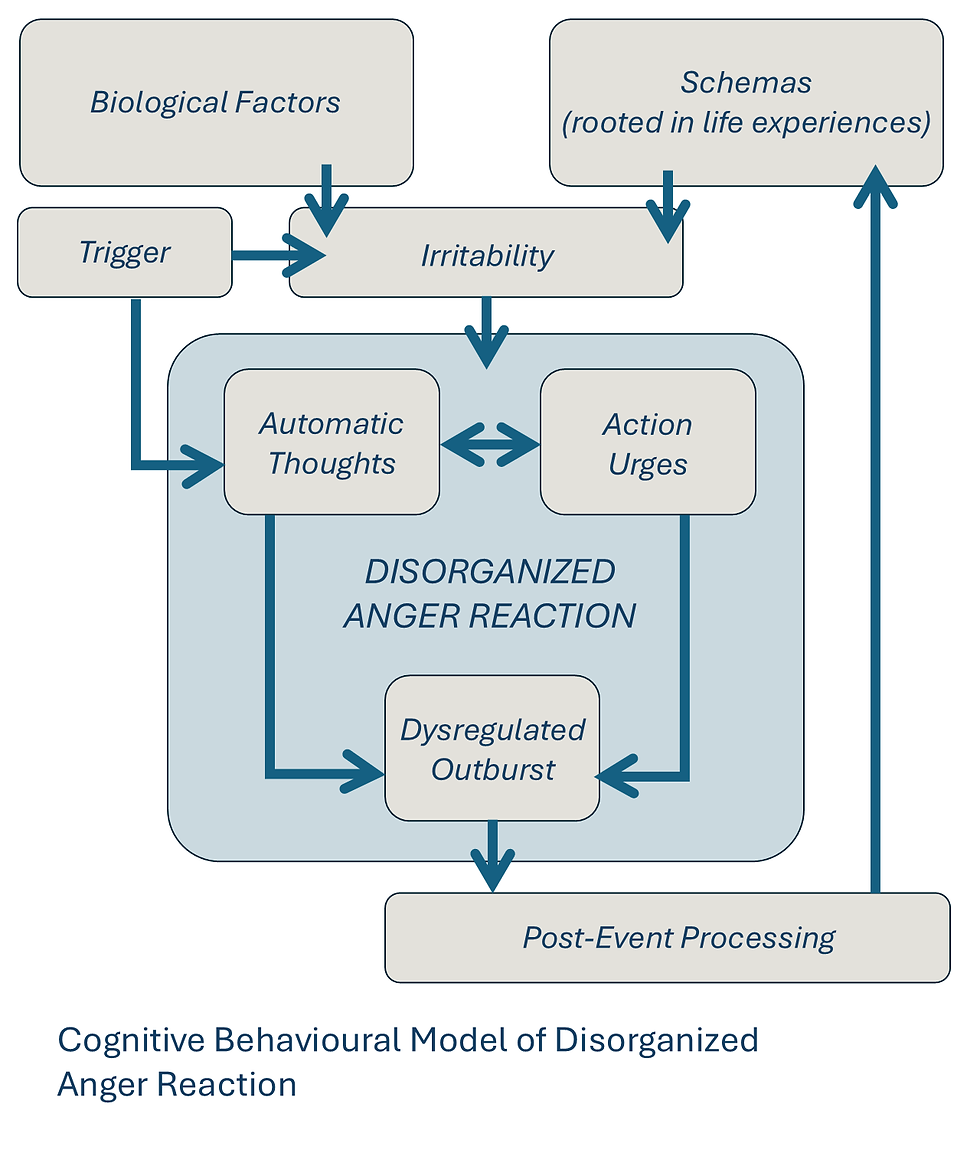
Layer 1: Vulnerability
Every angry reaction is born in a "petri dish" composed of your biology and your history.
Biological Speed: Some nervous systems simply escalate faster. This is the "Fight-Flight-Freeze" (FFF) response.
Schemas: These are the rules you learned about the world. If you grew up in an environment where only the loudest person was heard, your schema might be: “Aggression equals survival.”
Case Vignette 2: Bogdan prides himself on "not taking nonsense." Growing up in a rough neighborhood in Eastern Europe, he learned early that showing weakness was dangerous. Now, as a business owner, when a supplier makes a mistake, Bogdan explodes—shouting, demanding respect, and making a scene. The terrified supplier quickly fixes the issue just to get him off the phone. Bogdan hangs up feeling triumphant. "I showed them," he thinks. "You have to be tough to get what you want." Bogdan’s schema is reinforcing his disorganization. He mistakes the supplier’s fear-based compliance (placating a threat) for respect. He doesn't see that his business partners are embarrassed to be seen with him, or that his wife has stopped sharing her feelings because she fears "waking the bear." His disorganized outbursts are creating invisible rifts that will eventually leave him isolated, but his short-term "win" keeps him locked in the cycle.
Layer 2: Irritability (The "Watchfulness")
When the factors in the Petri Dish combine, they create a state of Watchfulness. This is a hyper-vigilant scanning for threats. You aren’t just living your life; you are unconsciously waiting for someone to disrespect you. This elevates your system's baseline.
Layer 3: The Trigger & Activation
A trigger occurs. It could be external (an interruption, a humiliation) or internal (a memory). Because it lands on a system that is already "Watchful," it doesn't just annoy you; it activates your system.
Automatic Thoughts: "They are doing this on purpose."
Action Urges: A sudden, physical impulse to yell, hit, or punish.
Layer 4: The Disorganized Angry Reaction
This is the critical pivot point. The combination of heightened physiological activation and intense cognitive distortion causes the system to scramble. You are no longer thinking strategically; you are reacting instinctively. You lose access to your "window of influence"—the ability to choose a response that actually serves your goals.
Case Vignette 3: Priya’s core desire is simple: she just wants to be understood. But she has a rapid-response nervous system. When her husband misunderstands a comment she made about their finances, Priya feels a flash of discomfort that quickly morphs into what feels like rage. She feels the misunderstanding as a threat to her very identity. Desperate to explain herself, she begins to shout, talk over him, and follow him from room to room. "You aren't listening to me!" she screams. Her husband, overwhelmed by the intensity, shuts down and walks away. Priya collapses in tears, feeling abandoned. Her disorganized attempt to force understanding has achieved the exact opposite: total disconnection.
Layer 5: The Behavioral Response
This is what the world sees.
Dysregulated: The explosion. Yelling, slamming doors, saying things you cannot unsay.
Over-Controlled: Alternatively, you may freeze or withdraw into a cold, seething silence, fantasizing about future revenge while appearing outwardly calm.
Layer 6: The Feedback Loop (Rumination)
The episode ends, but the process doesn't. You experience consequences (guilt, shame, conflict), which trigger Post-Event Processing.
Revenge Fantasies: You replay the event, imagining a "better" outcome where you dominate the other person.
Noble Victimhood: You tell yourself a story about how you were right and they were wrong.
These ruminations are not harmless thoughts; they are fuel. They feed directly back into Step 2, increasing your baseline irritability and confirming your hostile schemas, ensuring the next trigger will cause an even faster explosion.
Case Vignette 4: Mateo was extensively bullied throughout his childhood. He eventually found protection by joining a gang in his youth, where he learned that any sign of disrespect had to be met with overwhelming force. Though he has long since left that life and works in construction, his system is still primed for the threat. When his foreman gives him mild constructive feedback about a safety protocol, Mateo’s system does not process "feedback." It registers "threat." His PTSD history means his baseline watchfulness is nearly constant. He becomes instantly defensive, perceiving the foreman’s tone as abusive. He cannot disengage. He spends the next hour arguing his point, digging up past examples of his good work, and accusing the foreman of targeting him. He is unable to see that the feedback was minor; his disorganized reaction has turned a routine correction into a disciplinary issue. Mateo leaves work feeling persecuted, his belief that "the world is dangerous" cemented even further.
Part 3: Intervention Strategies – Reclaiming Capacity for Effective Interactions
Interpersonal effectiveness doesn't come from suppressing anger, but from understanding each layer before clarity and effectiveness are compromised. Our goal is to reclaim and maintain our "window of coherence," enabling us to cultivate calm, goal-oriented responses. To do so, we need to spend a lot of time tracking our physiological responses, challenging our schemas, learning to replace hypervigilance with alertness and, finally, having a plan for what to do when a potential for an outburst is looming in the background. Remember: Not acting out in anger does not make you a doormat.
The intervention strategies outlined in this article are designed to disrupt the anger cycle at multiple points, working simultaneously on preventing escalation and providing tools for in-the-moment self-control. We work proactively on the first three key drivers—irritability, behavioral schemas, and rumination—in the background, through consistent behavioral experiments, cognitive restructuring, and "inoculation" or exposure to difficult interactions. This foundational work significantly reduces the likelihood and intensity of a dysregulated outburst, while still offering robust strategies for self-control when faced with high levels of physiological arousal.
Addressing Baseline Irritability (The "Biological Hum" and Hypervigilance)

Some people’s nervous systems are simply wired to escalate more rapidly, meaning they may experience intense physiological reactions when confronted with stress or perceived threats. Recognizing these biological tendencies is essential—but it’s not an excuse for reacting poorly or lashing out. Think of it like allergies: just because someone has allergies and is prone to watery eyes, sneezing, or coughing, doesn’t mean we expect them to sneeze or cough on everyone nearby. The biological reality is there, but social responsibility remains. In fact, someone with allergies might offer a quick explanation—"Don't worry, it's just allergies"—to reassure others and reduce unnecessary concern. Similarly, when you notice your fight-flight-freeze responses kicking in, a simple, honest comment like “Sorry, I’ve got a lot on my mind right now” can go a long way to diffuse tension and prevent misunderstandings. We owe it to ourselves to not be at a mercy of our physiological responses. We can do so through mindfulness practice, progressive muscle relaxation, learning to shift from hypervigilance to alertness and anger inoculation training.
Mindfulness for Physiological Awareness:
Techniques like body scans and focused attention to interoceptive cues (e.g., noticing muscle tension, heart rate changes, or feelings of warmth) help us become acutely aware of our body's early warning signs of arousal. It takes practice to read ourselves well, but by noticing these subtle shifts before full activation, we can intervene earlier. Regular mindfulness practice enhances this internal awareness, allowing for a quicker recognition of the physiological onset of anger, giving us the crucial data needed to self-assess our level of activation, such as whether we are in a 'calm and present' (0-25), 'alert ' (25-50), 'heightened arousal' (50-75), or 'fight-flight-freeze' (above 75) state. For Mei Lin, mindfulness would help her catch the early internal tension building before she retreats into her elaborate fantasies. Bogdan could use mindfulness to detect the physiological cues of his fight flight freeze response kicking in before he explodes at a supplier. Mateo, given his PTSD history, would find mindfulness crucial for detecting the earliest signs of threat arousal, allowing him to intervene before his system registers "threat" from minor feedback.
Progressive Muscle Relaxation (PMR)
PMR involves systematically tensing and then consciously relaxing different muscle groups throughout the body. This practice serves a dual purpose: first, it teaches us that a relaxed body state is not inherently dangerous or a sign of weakness; in fact, it's a powerful state of control. Second, by regularly engaging in PMR, we can effectively lower our overall physiological arousal, helping to reduce the body's baseline state of tension and making us less prone to rapid escalation. This is a foundational skill that allows us to actively engage with and modulate our body's stress response. PMR could help Mei Lin and Mateo lower their constantly elevated baselines, making them less "on edge" and reactive.
Shifting from Hypervigilance to Alertness: It's crucial to distinguish between chronic hypervigilance and useful alertness. Hypervigilance is a pervasive, unconscious scanning for danger that taxes the nervous system and keeps us on edge. Alertness, by contrast, is a focused, adaptive attention to present circumstances without the pervasive expectation of harm. Our goal is to move from generalized, exhausting hypervigilance to discerning, energy-efficient alertness. This involves challenging the very concept of "watchfulness" as a protective mechanism.
Challenging Positive Beliefs about Watchfulness:
Many people hold positive beliefs about their watchfulness, often thinking it keeps them safe or ready (e.g., "If I'm not constantly on guard, I'll be caught off guard" or "Being watchful means I am prepared"). Through metacognitive interventions, we challenge these beliefs by exploring their actual efficacy. Does constant vigilance truly make us more effective, or does it drain energy, narrow our focus, and amplify minor stressors into perceived threats? We learn to question whether our "watchfulness" is actually a helpful strategy or a self-perpetuating cycle of anxiety and reactivity.
Anger Inoculation Training: Inspired by Donald Meichenbaum's stress inoculation model [1], this strategy involves intentionally and systematically exposing ourselves to mildly irritating situations. These might be carefully chosen environments (e.g., a slightly crowded space, a busy intersection) or low-stakes interactions (e.g., a minor inconvenience in a queue). Our task is to consciously practice maintaining a calm, goal-oriented demeanor despite internal physiological or emotional discomfort. This isn't about ignoring the irritation but learning to sustain effective functioning and quiet effectiveness despite body reactivity.
Reshaping Behavioral Schemas (Our Internal Rulebook)
Our behavioral schemas, rooted in our personal history, act as an internal rulebook, dictating how we believe the world works and how we must respond. Challenging and building more functional schemas is central to breaking the anger cycle.
Cognitive Restructuring:
This involves identifying, questioning, and replacing irrational or unhelpful beliefs that underpin our schemas. For Bogdan, it means examining the actual long-term consequences of his outbursts (damaged relationships, fear, not genuine respect) versus the perceived short-term "win." We might explore alternative beliefs like, "Effective leadership involves calm assertiveness and clear communication, not intimidation," or "True strength comes from self-control and respect, not brute force." This process helps us see our old rules for what they are – often outdated survival strategies that no longer serve us.
Building Functional Schemas through Behavioral Experiments:
Rather than just intellectual insight, building more functional schemas is primarily achieved through active behavioral experiments. We practice gentle assertiveness in low-stakes situations and observe the actual outcomes. Mei Lin, for example, might intentionally express a minor disagreement or preference in a meeting. By experiencing that the feared catastrophic outcomes do not materialize, and perhaps even finding that her gentle assertiveness is effective, she gradually builds a new schema: "I can speak up and manage conflict effectively and respectfully, without being overwhelmed or being a doormat." These repeated positive experiences reinforce more adaptive ways of interacting with the world, rewriting our internal rulebook with real-world evidence. For Bogdan, this might involve calmly discussing an issue with a supplier without yelling, and observing that the problem is still resolved, but without the negative relational impact. For Mateo, behavioral experiments could involve accepting minor, non-threatening feedback calmly, and seeing that no harm comes to him, thereby helping to shift his "world is dangerous" schema.

Disrupting Rumination and Fantasy (The Internal Fire)
Rumination and fantasy are the mental engines that keep the anger cycle burning long after the event, feeding our irritability and reinforcing our schemas. Disrupting this post-event processing is crucial for long-term change through intentionality and metacognitive strategies.
Attention Shift for Rumination: This metacognitive strategy involves a conscious, intentional effort to disengage from unhelpful mental replays or fantasies.
First, we recognize the rumination for what it is – a mental activity, not necessarily productive problem-solving.
Second, we remind ourselves of the intended function versus its actual impact. Often, we ruminate with the intention of solving a problem, processing an event, or preventing future harm. However, we learn to recognize that rumination frequently has the actual impact of increasing our irritability, reinforcing negative schemas, and keeping us stuck in the past rather than moving forward.
Third, we make an intentional shift of attention to something of more value. This could be a constructive task, an engaging hobby, present-moment sensory input, or focusing on immediate problem-solving steps. Mei Lin, for instance, can recognize her elaborate "monologue" fantasies as unhelpful rumination. She can then remind herself that these fantasies aren't actually helping her process or prepare effectively, and intentionally shift her attention to planning her next day's work or a specific, small step towards actual communication.
Compassionate Self-Accountability:
After an angry incident or a period of rumination, this approach encourages us to take ownership of our role in the situation or our internal processing, but with an understanding, learning-oriented perspective rather than harsh self-criticism. It's about compassionate course correction. This means acknowledging what happened, our part in it, and the impact it had (accountability), but doing so with a focus on what we can learn and do differently next time (compassion). This breaks the "noble victimhood" narrative by fostering growth and agency. Priya, rather than collapsing in tears and feeling abandoned, can compassionately acknowledge her escalation contributed to the disconnection, and then accountably strategize ways to communicate more effectively. Bogdan can use compassionate self-accountability to recognize the relational damage of his "triumphant" outbursts, shifting from a "winner" narrative to one of building trust and respect through different means. For Mateo, this involves acknowledging his past trauma and how it influences his reactivity, while also taking accountability for his current responses and actively working to develop healthier coping mechanisms.
Future-Oriented Problem-Solving:
Instead of dwelling on what went wrong in the past, we intentionally shift our focus to what can be done differently next time. For Mateo, after a difficult interaction, this means asking, "What could I do or say next time to better advocate for myself without escalating?" rather than replaying the argument and feeling persecuted. This shift redirects mental energy from harmful rumination to constructive planning and skill development. Priya might ask, "What specific communication strategy can I use to ensure I'm understood next time?"
Managing the Dysregulated Outburst (Reclaiming In-Moment Control)
While the dysregulated outburst is deeply rooted in our biological vulnerabilities, schemas, and ruminative patterns, it still offers significant room for self-control depending on our level of physiological arousal. This section outlines both proactive strategies to prepare for triggers and in-the-moment techniques to navigate high-arousal situations, preserving our window of coherence – our ability to stay rational and goal-oriented.
A. Preparing for Triggers & Reducing Activation Speed (Proactive Work):
Trigger Identification and Self-Monitoring: Continuing to journal and reflect on past angry episodes helps us pinpoint specific internal (e.g., memories, hunger, fatigue) and external (e.g., specific people, comments, situations) triggers. Understanding these patterns allows us to anticipate and prepare for situations that commonly lead to anger, rather than being caught off guard. This is where Mei Lin identifies interruptions as a trigger, Bogdan recognizes supplier errors, Priya notes misunderstandings with her husband, and Mateo pinpoints feedback perceived as a threat.
Recognizing Early Warning Signs: Building upon mindfulness practices from our work on irritability, we become more adept at identifying the subtle physical, cognitive, and emotional cues that signal the onset of an angry reaction, well before it becomes overwhelming. This refined awareness is crucial for early intervention. Mei Lin might notice her internal tension building; Bogdan, an immediate heat; Priya, a flash of discomfort; and Mateo, instant defensiveness.
Proactive Thought Challenging: We prepare for potential triggers by practicing the skill of challenging automatic, distorted thoughts. When a trigger appears, thoughts like "They are doing this on purpose" or "This is completely unfair" can hijack our emotional state. By having previously trained ourselves to pause and question these interpretations ("Is this interpretation definitely true? What are other possible explanations? Is this thought helping me right now?"), we create a cognitive "speed bump" that interrupts the rapid cascade of negative thought patterns, reducing the immediate cognitive distortion that fuels quick escalation. Mateo might practice "This is just feedback, not an attack."
Mindfulness of Action Urges: This skill involves practicing before and during activation to simply notice the urge to yell, lash out, or withdraw, without immediately acting on it. By observing the urge non-judgmentally and allowing it to pass, we develop a crucial internal pause button. This deliberate separation between impulse and action slows down the reactive cycle and preserves our ability to choose a more effective response. Priya and Bogdan could practice mindfulness of their urges to shout. Mei Lin could practice noticing her urge to withdraw without acting on it.
Practice of Effective Responses through Inoculation: This is a crucial preparatory step that blends elements from DBT interpersonal effectiveness skills, emotion regulation, and Meichenbaum's inoculation model. We engage in structured training and exposure hierarchies to practice new, adaptive responses before being confronted with high-stakes situations.
Role-Plays and Assertiveness Training: Through role-plays, we practice assertive communication, de-escalation techniques, and emotional regulation skills in safe, controlled environments. Assertiveness training focuses on expressing needs, setting boundaries, and disagreeing respectfully without resorting to aggression or submission.
Exposure Hierarchies: We systematically practice effective responses in low-activation situations (e.g., calmly disagreeing with a trusted, non-activating friend about a minor issue). Gradually, we move to higher-activation scenarios (e.g., engaging in a calm discussion with someone with whom there's a history of conflict, or addressing a recurrent, frustrating situation). This systematic, pre-emptive practice builds confidence, resilience, and the capacity to maintain composure and clarity even when a strong trigger arises. For Mei Lin, this means practicing assertive statements in low-stakes interactions. Bogdan could role-play calmly addressing a hypothetical supplier issue. Priya could practice articulating her needs to a supportive friend before trying with her husband.
B. Navigating Our Window of Coherence (In-Moment Strategy):
This sub-section focuses on in-the-moment strategies for managing our physiological arousal to ensure we stay within our window of coherence when a difficult situation arises. We utilize an activation/arousal scale to guide our response:

0-25 (Calm & Present): In this zone, our executive functions are fully online. We can engage in calm, rational conversation, thoughtful problem-solving, and open dialogue without significant effort. We are operating within our optimal window of coherence.
25-50 (Alert): As our physiological arousal rises slightly, perhaps a little tension or increased heart rate, we need to ensure we're following a clear and simplified script for effective communication. This "OPEN" framework helps us stay on track:
Objective: Clearly identify what we want to achieve in the interaction.
Plan: Outline how we intend to achieve that objective.
Explanation: Provide a clear explanation of our perspective and actively ask for the other person's explanations as well.
Negotiables/Non-negotiables: Have clarity about what aspects of the situation are flexible and what boundaries are firm.
50-75 (Heightened Arousal): When our physiological response reaches this level—noticeable physical sensations like a racing heart, tightened jaw, or flushed face—we consciously work on slowing our speech and, if appropriate, ask the other person to calmly explain their requests or positions. This deliberate slowing can help both parties regulate and prevent further escalation. We remember that WHEN WE LOSE OUR DIGNITY, WE ARE LOSING THE HIGHER GROUND. This is a critical point where we actively choose self-control over impulsive reaction. Priya, catching herself at this level, could slow her speech and ask her husband to calmly rephrase his understanding. Mateo, feeling the physical signs of escalation, might use a pre-planned statement like, "I hear you, let me take a moment to process this feedback fully."
Above 75 (Fight-Flight-Freeze): If we notice our physiological response goes over 75, it's crucial to excuse ourselves from the conversation immediately. At this level, we are no longer able to engage in productive interactions. This isn't avoidance but a strategic pause to regain composure. We then work on calming our physiological body response before returning to the conversation. For interactions with people we have frequent contact with (e.g., family, colleagues), it's essential to always return to the conversation to address the issue constructively. However, in situations with low long-term importance (e.g., a potential road rage incident, an annoying employee at a bank), we might simply decide that reaching our immediate goal is not worth the emotional outburst or loss of personal dignity. Bogdan, recognizing his rapid jump to 75+, would know to pause, perhaps saying, "I need a moment to collect my thoughts on this," before escalating on the phone. Mateo, if feeling completely overwhelmed, would excuse himself, saying, "I need a few minutes to step away from this and compose myself, then I'd like to discuss it calmly."
When we excuse ourselves to de-escalate, we can utilize techniques like TIPP (Temperature, Intense Exercise, Paced Breathing, Paired Muscle Relaxation) if necessary, to rapidly bring down physiological arousal. This includes using cold water on the face (Temperature), brief intense physical activity (Intense Exercise), slow, deep breathing (Paced Breathing), and progressive muscle relaxation (Paired Muscle Relaxation). Hopefully, due to our inoculation practice, our physiology will not be responding as fast or as intensely as before, making this self-regulation more effective.
Successful intervention means consistently using the communication skills we've learned and not allowing ourselves to be hijacked by physiological arousal or maladaptive schemas. It means choosing to engage constructively, even when feeling challenged, thereby reinforcing our ability to respond effectively rather than react impulsively. Most importantly, if an interaction goes well despite initial feelings of anger, we have actively changed our schema and reinforced a better, more effective way of communicating. It's vital to recognize that many angry interactions look "successful" because the other person does not feel like arguing or simply gives in to avoid conflict. This does not mean they have agreed with us or that the underlying issue is resolved. Being calmly assertive, as guided by our understanding of the Window of Coherence, helps us to have a full, honest view of where the other person truly stands, leading to genuine understanding and lasting resolution.

In Conclusion
Some approaches to anger management might fall short because they oversimplify a complex process. This article has outlined a comprehensive cognitive behavioral model that redefines anger not as a simple emotion, but as a "disorganized angry reaction" – a critical breakdown in clear thinking and effective action.
The unchecked costs of this disorganization are high, leading to significant interpersonal damage, sustained internal distress through rumination, and a consistent failure to achieve desired outcomes. By following this multifactor model, we can make a strategic investment in self-awareness and proactive skill development. The benefits are profound: a pathway to moving beyond impulsive outbursts or passive withdrawal towards calm, goal-oriented responses. This involves cultivating physiological self-regulation, reshaping ingrained beliefs, and disrupting destructive thought patterns. Ultimately, the model empowers us to maintain a "window of coherence," enabling clearer communication, genuine understanding, and building more resilient relationships. Letting go of anger does not require letting go of our principles. In fact, the opposite is true: we can act on our principles with increased effectiveness [2] and regain our sense of self.
Treatment of Individuals with Anger-Control Problems and Aggressive Behaviour (2003) is a very detailed treatment manual developed by Donald Meichenbaum. This work is aimed at clinicians, not persons with anger difficulties. How to Control Your Anger Before It Controls You: Recognize Your Triggers, Calm Down Fast and Respond Instead of Reacting (2025) by Maya Grey is a good self-help alternative that does not oversimplify the problem.
This article talks a lot about learning to adjust unhelpful schemas and automatic thoughts. Schemas are not our principles. Schemas are conditioned patterns of responding that develop overtime and subconsciously influence our responses. Principles are our ethical guidelines that we have consciously decided on.


